

Aluminum Die Casting
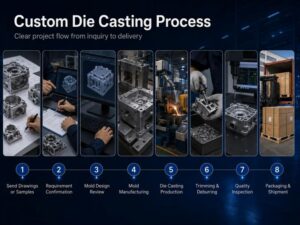 Aluminum die casting is the dominant high-volume manufacturing process for lightweight, complex metal components used across automotive, industrial machinery, electronics, hydraulic and agricultural sectors. At ChinaMetalCastings, we provide full-service high-pressure aluminum die casting, covering conventional standard aluminum alloys as well as cutting-edge aluminum matrix composite (Al-MMC) casting materials. Our engineering and production team supports overseas OEM buyers from initial DFM analysis, mold making, sample validation, mass production to final dimensional and material inspection. If you are searching for a reliable aluminum die casting manufacturer in China for custom housings, brackets, pump bodies and structural components, our service is built to meet your drawing, tolerance and performance specifications.
High-pressure die casting injects molten aluminum alloy into hardened steel dies under fast, controlled pressure. This manufacturing method excels at forming thin-wall, intricate geometries that are difficult or uneconomical via sand casting or investment casting. To learn about our full casting capabilities, visit our main die casting service page. Aluminum is favored for die casting thanks to its low density, excellent thermal conductivity, good castability and wide range of available surface treatments. Compared with heavier ferrous cast metals, aluminum die cast parts help end customers reduce assembly weight, improve energy efficiency and cut shipping costs for finished equipment.
Common Aluminum Die Cast Alloys: A380 (ADC10) and A360 (ADC3)
Two alloy grades make up the majority of standard aluminum die casting orders: A380, also known as ADC10, and A360, referred to as ADC3. Each alloy carries a unique set of strengths and limitations that must guide your material selection.
A380 / ADC10 is the most widely used general-purpose die casting aluminum alloy. It features excellent mold filling capacity, balanced tensile strength and acceptable corrosion resistance. This makes A380 ideal for electronic enclosures, machinery covers, automotive brackets and non-pressure-critical housings. It delivers stable production yield and relatively low machining difficulty, helping control total part cost for large batch orders.
A360 / ADC3 sacrifices a small amount of fluidity in exchange for superior pressure tightness and corrosion resistance. For parts exposed to hydraulic oil, continuous moisture or static sealing loads, A360 is often the better choice. Our engineering team will review your working environment, load requirements and surface treatment plans before recommending the correct alloy for your project. You can browse real finished aluminum casting samples we have delivered in our Project Gallery.
Advanced Al-MMC Silicon Carbide Reinforced Aluminum Composites
A newer, high-performance material option for specialized applications is Al-MMC, or aluminum matrix composite die casting. Al-MMC die cast materials have emerged over the past decade and remain far from mainstream use in global casting supply chains.
This composite material is created by adding silicon carbide (SiC) particles, at a mass percentage of 10% to 20%, into a base A380 or A360 aluminum alloy matrix. The reinforcement delivers dramatic mechanical improvements: tensile strength can rise between 40% and 90% compared with the original aluminum alloy substrate.
Composite grades follow a clear naming convention. The base metal and reinforcement percentage are separated by a slash. The common grades we support include F3D.10S-F (380/SiC/10p), F3D.20S-F (380/SiC/20p), F3N.10S-F (360/SiC/10p) and F3N.20S-F (360/SiC/20p). The “10p” and “20p” labels represent 10% and 20% silicon carbide particle loading.
We evaluate these composite materials using a simple 1–5 rating scale, where a score of 1 stands for excellent performance and 5 means poor performance. Ratings from 2 to 4 reflect intermediate characteristics.
Performance Profile of A380-Based Al-MMC (F3D Series)
Both 10% and 20% SiC reinforced F3D composites have top-tier resistance to hot tearing, excellent mold cavity filling, stable strength retention at elevated temperatures and outstanding wear resistance. These properties make them attractive for high-load sliding and structural components.
The main tradeoff comes from machinability. Hard SiC ceramic particles rapidly wear standard carbide cutting tools. Polycrystalline diamond cutting tools, also called DCD tools, are required for consistent machining results. Tooling and processing costs can increase 3–4 times versus regular A380 aluminum, which is the biggest barrier to mass adoption of Al-MMC die castings. Polishing these composite parts is also challenging, while electroplating performance remains moderate.
Performance Profile of A360-Based Al-MMC (F3N Series)
F3N composites built on the A360 base inherit the parent alloy’s strong air tightness and corrosion resistance. The downside is limited surface anodizing capability. Especially for the 20% SiC variant F3N.20S-F, forming uniform, reliable anodic protective coatings becomes extremely difficult.
This is a critical point for procurement engineers. If your finished part requires decorative anodizing, hard anodized coating or consistent cosmetic surface finish, standard A360 or A380 aluminum alloy will nearly always be the more practical, cost-effective choice. Al-MMC is not a drop-in replacement for conventional aluminum die casting.
When to Choose Al-MMC Composite Aluminum Die Casting
Al-MMC is targeted for niche high-performance use cases where lightweighting and wear resistance are top priorities. Typical applications include heavy machinery sliding components, high-stress automotive transmission parts and structural brackets where designers want thinner wall sections without sacrificing load capacity.
We do not recommend Al-MMC for consumer-facing housings requiring cosmetic finishes, low-cost commodity parts, or components requiring extensive milling, tapping and secondary machining. The extra material and tooling cost is difficult to justify for these projects.
Producing Al-MMC also needs modified casting parameters. The molten composite slurry must be carefully agitated inside the furnace to avoid SiC particle segregation and clustering. Injection speed, die temperature and intensification pressure settings differ significantly from standard aluminum die casting recipes. Poor process control leads to porosity, uneven particle distribution and inconsistent mechanical strength. Our foundry team completes DFM reviews and process trials before formal mold release for composite projects. Our complete testing and validation workflow is documented on our quality inspection process page.
Design for Manufacturability (DFM) & Common Aluminum Die Casting Defects
DFM review is the first step of every aluminum die casting project. Many quality problems happen due to improper draft angles, sharp internal corners, uneven wall thickness, overly thick isolated sections or poorly designed ribs.
Common aluminum die casting defects include cold shuts, trapped gas porosity, shrinkage cavities, flash, blisters and surface flow marks. We have created a dedicated technical guide covering root causes and corrective actions for these recurring issues. Read our full guide: aluminum die casting defects and troubleshooting.
When submitting a request for quotation, please share your 2D drawings, 3D STEP files, alloy requirements, tolerance callouts and surface finish specifications. This information allows our team to calculate mold cost, piece price, lead time and flag material risks before you invest in tooling.
Industry Applications of Custom Aluminum Die Castings
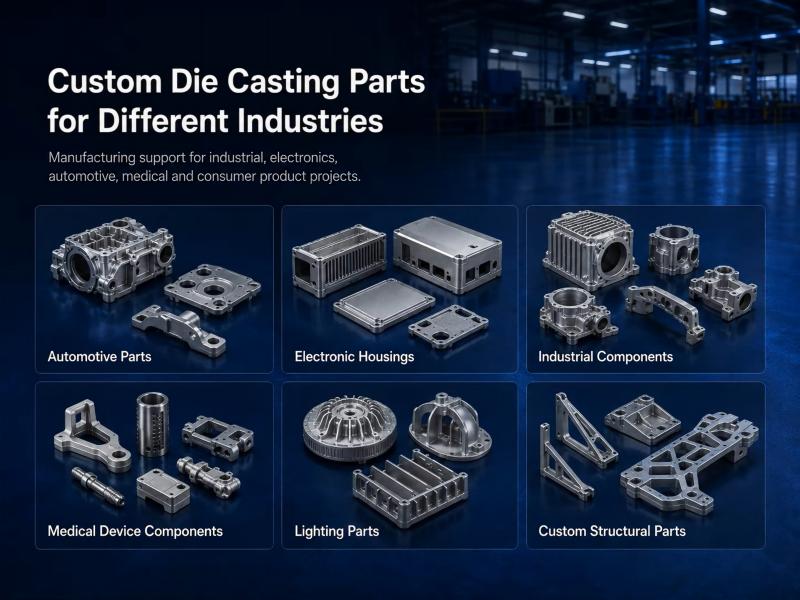
Aluminum die cast components serve a wide range of industrial markets. The automotive sector is our largest vertical. Lightweight aluminum castings help OEMs reduce vehicle curb weight, cut fuel consumption and extend driving range for electric vehicles. See our dedicated page for more automotive casting examples: automotive casting parts.
We also supply aluminum die castings for agricultural equipment, hydraulic valve assemblies, power electronics housings, pump bodies and industrial automation frames. For automotive batches requiring strict quality control, we follow IATF 16949 standards; all general industrial orders run under ISO 9001 quality management.
Surface Finishing Options
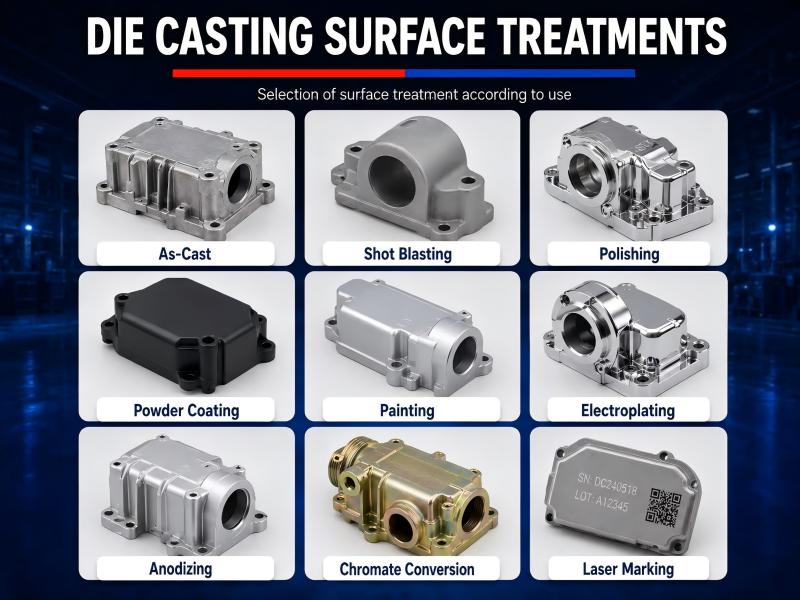
Standard A380 and A360 aluminum die castings support a broad selection of post-processing finishes: shot blasting, vibratory deburring, passivation, powder coating, liquid painting and electroplating.
For Al-MMC composite castings, finishing options are heavily restricted. High silicon carbide content makes consistent plating and anodizing difficult with high reject risk. Most Al-MMC parts are delivered as-cast or shot-blasted unless the buyer accepts elevated failure rates and extra processing expense. Our sales team will clearly communicate these limitations at quotation stage.
MOQ, Lead Time & Trade Terms
For standard A380 and A360 aluminum die castings, our minimum order quantity starts at several hundred pieces for simple components. Al-MMC composite castings carry a higher MOQ, because composite material preparation, furnace cleaning and PCD machining setup create larger fixed overhead. We support prototype trial runs for composite development projects, with clear pricing for small validation batches.
Our full service scope includes mold design, die fabrication, first article sampling, mass production, in-process inspection, packaging and global shipping. We support EXW, FOB and DDP delivery terms for customers across North America, Europe, Australia and Southeast Asia.
FAQ
What is the difference between A380 and A360 aluminum die casting alloy?
A380 (ADC10) has superior fluidity for complex thin-wall shapes and lower cost; A360 (ADC3) provides better air tightness and corrosion resistance for sealing and hydraulic applications.
What is Al-MMC aluminum die casting?
Al-MMC is aluminum matrix composite material, made by mixing silicon carbide (SiC) particles into molten aluminum alloy, delivering much higher strength and wear resistance at the cost of harder machining and limited surface treatment.
Can Al-MMC die cast parts be anodized?
Anodizing performance is poor for Al-MMC, especially with 20% SiC loading. We generally avoid anodizing requirements for composite castings.
What tolerances can you hold on aluminum die cast parts?
We follow standard high-pressure die casting tolerance specifications, and tighter critical dimensions can be achieved via secondary CNC machining after casting.
Get Your Aluminum Die Casting Quotation
Whether your project uses conventional A380 / A360 aluminum or advanced SiC reinforced Al-MMC composite, our technical sales team can provide a free DFM review. Send your engineering drawings to us, and we will deliver a transparent quotation including tooling timeline, unit price and quality control plan.